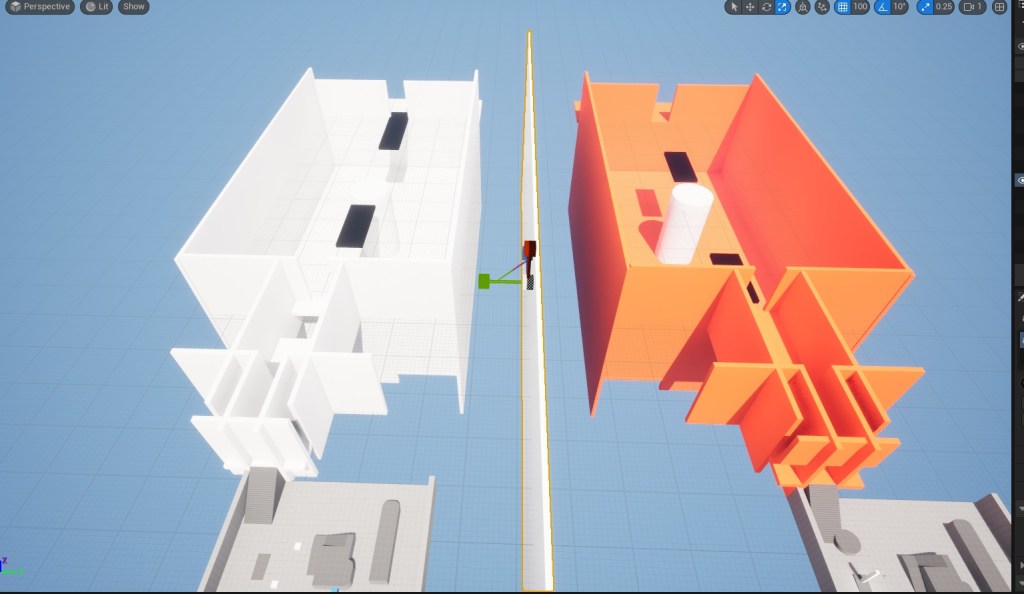
For this white room prototype, I am exploring a dual-world switching mechanic. The player can switch between a “surface world” and an “inner world.” Both worlds share the same spatial layout, but their navigability and connections differ.
Core Mechanic
The basic mechanic is Jump & Switch.
The player can:
- Move and jump normally
- Instantly switch between the two worlds
Each world has different accessible paths. Platforms, bridges, and connections exist in one world but not in the other. The player must use spatial memory and timing to move between layers.
The mechanic is not based on complex physics or visual effects. Instead, it focuses on:
- Spatial difference
- Connectivity change
- Vertical displacement
Scale & Movement
The level is building-scale, approximately a small interior structure composed of:
- An entry space
- A central vertical hall
- A final goal space
The player is walking and jumping (third-person scale). There is no AI at this stage. The focus is purely on spatial logic and mechanical clarity.
Layout & Flow
The level is structured in three phases:
- Introduction
The surface world door is closed. The player switches to the inner world to enter. This teaches the core mechanic. - Path Divergence
A corridor collapses in the inner world, forcing the player to return to the surface world to proceed. This establishes that both worlds have different navigable paths. - Jump & Switch Sequence
In a double-height central space:- In the surface world, an upper bridge exists.In the inner world, the upper bridge is broken, but a lower platform appears.
This sequence expands the mechanic from simple switching to spatial anticipation and timing.
 Course Blog
Leave a comment